May 1946 Pg31

|

|

|
Return to the 1946 thumbnail index

Home Page

© 1998-2017 www.americanhelicoptermag.com
|
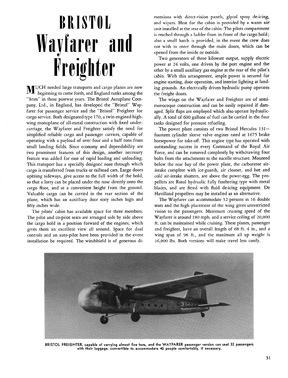
BRISTOL Wayfarer and Freighter Much needed large transports and cargo planes are now beginning to come forth, and England ranks among the "firsts" in these postwar years. The Bristol Aeroplane Company, Ltd., in England, has developed the "Bristol" Wayfarer for passenger service and the "Bristol" Freighter for cargo service. Both designated type 170, a twin-engined highwing monoplane of all-metal construction with fixed undercarriage, the Wayfarer and Freighter satisfy the need for simplified reliable cargo and passenger carriers, capable of operating with a payload of over four and a half tons from small landing fields. Since economy and dependability are two prominent features of this design, another necessary feature was added for ease of rapid loading and unloading. This transport has a specially designed nose through which cargo is transferred from trucks or railroad cars. Large doors opening sideways, give access to the full width of the hold, so that a lorry can be placed under the nose directly onto the cargo floor, and at a convenient height from the ground. Valuable cargo can be carried in the rear section of the plane, which has an auxilliary door sixty inches high and fifty inches wide. The pilots' cabin has available space for three members. The pilot and co-pilot seats are arranged side by side above the cargo hold in a position forward of the engines, which gives them an excellent view all around. Space for dual controls and an auto-pilot have been provided in the event installation be required. The windshield is of generous dimensions with direct-vision panels, glycol spray de-icing, and wipers. Heat for the cabin is provided by a warm air unit installed at the rear of the cabin. The pilots compartment is reached through a ladder from in front of the cargo hold; also a small hatch is provided, in the event the crew does not wish to enter through the main doors, which can be opened from the inside or outside. Two generators of three kilowatt output, supply electric power at 24 volts, one driven by the port engine and the other by a small auxiliary gas engine at the-rear of the pilot's cabin. With this arrangement, ample power is secured for engine starting, door operation, and interior lighting at landing grounds. An electrically driven hydraulic pump operates the freight doors. The wings on the Wayfarer and Freighter are of semimonocoque construction and can be easily repaired if damaged. Split flaps are employed which also operate hydraulically. A total of 600 gallons of fuel can be carried in the four tanks designed for pressure refueling. The power plant consists of two Bristol Hercules 131- fourteen cylinder sleeve valve engines rated at 1675 brake horsepower for take-off. This engine type has operated with outstanding success in every Command of the Royal Air Force, and can be removed completely by withdrawing four bolts from the attachments to the nacelle structure. Mounted below the rear bay of the power plant, the carburetor airintake complete with ice-guards, air cleaner, and hot and cold air-intake shutters, are above the power-egg. The propellers are Rotol hydraulic fully feathering type with metal blades, and are fitted with fluid de-icing equipment. De Havilland propellers may be installed as an alternative. The Wayfarer can accommodate 32 persons in 16 double seats and the high placement of the wing gives unrestricted vision to the passengers. Maximum cruising speed of the Wayfarer is around 180 mph, and a service ceiling of 20,000 ft. can be maintained while cruising. These planes, passenger and freighter, have an overall length of 68 ft. 4 in., and a wing span of 98 ft., and the maximum all up weight is 36,000 lbs. Both versions will make travel less costly. BRISTOL FREIGHTER, capable of carrying almost five tons, and the WAYFARER passenger version can seat 32 passengers with their luggage, convertible to accommodate 40 people comfortably, if necessary. |