May 1946 Pg32-33

|

|

|
Return to the 1946 thumbnail index

Home Page

© 1998-2017 www.americanhelicoptermag.com
|
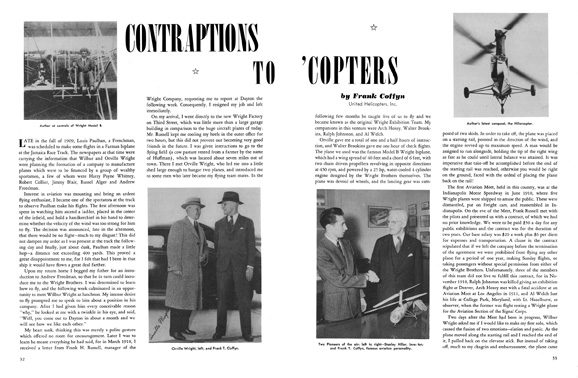
CONTRAPTIONS TO 'COPTERS by Fronk Collyn United Helicopters, Inc. Late in the fall of 1909, Louis Paulhan, a Frenchman, was scheduled to make some flights in a Farman biplane at the Jamaica Race Track. The newspapers at that time were carrying the information that Wilbur and Orville Wright were planning the formation of a company to manufacture planes which were to be financed by a group of wealthy sportsmen, a few of whom were Harry Payne Whitney, Robert Collier, Jimmy Blair, Russel Alger and Andrew Freedman. Interest in aviation was mounting and being an ardent flying enthusiast, I became one of the spectators at the track to observe Paulhan make his flights. The first afternoon was spent in watching him ascend a ladder, placed in the center of the infield, and hold a handkerchief in his hand to determine whether the velocity of the wind was too strong for him to fly. The decision was announced, late in the afternoon, that there would be no flight-much to my disgust! This did not dampen my ardor as I was present at the track the following day and finally, just about dusk, Paulhan made a little hop-a distance not exceeding 400 yards. This proved a great disappointment to me, for I felt that had I been in that ship it would have flown a great deal farther. Upon my return home I begged my father for an introduction to Andrew Freedman, so that he in turn could introduce me to the Wright Brothers. I was determined to learn how to fly, and the following week culminated in an opportunity to meet Wilbur Wright at luncheon. My intense desire to fly prompted me to speak to him about a position in his company. After I had given him every conceivable reason "why," he looked at me with a twinkle in his eye, and said, "Well, you come out to Dayton in about a month and We will see how we like each other." My heart sank, thinking this was merely a polite gesture which offered no room for encouragement. Later I was to learn he meant everything he had said, for in March 1910, I received a letter from Frank H. Russell, manager of the Wright Company, requesting me to report at Dayton the following week. Consequently, I resigned my job and left immediately. On my arrival, I went directly to the new Wright Factory on Third Street, which was little more than a large garage building in comparison to the huge aircraft plants of today. Mr. Russell kept me cooling my heels in the outer office for two hours, but this did not prevent our becoming very good friends in the future. I was given instructions to go to the flying field (a cow pasture rented from a farmer by the name of Huffman), which was located about seven miles out of town. There I met Orville Wright, who led me into a 'little shed large enough to hangar two planes, and introduced me to some men who later became my flying team mates. In 'the following few months he taught five of us to fly and we became known as the original Wright Exhibition Team. My companions in this venture were Arch Hoxey, Walter Brookins, Ralph Johnston, and Al Welch. Orville gave me a total of one and a half hours of instruction, and Walter Brookins gave me one hour of check flights. The plane we used was the famous Model B Wright biplane, which had a wing spread of 40 feet and a chord of 6 feet, with two chain driven propellers revolving in opposite directions at 450 rpm, and powered by a 25 hp, water-cooled 4 cylinder engine designed by the Wright Brothers themselves. The plane was devoid of wheels, and the landing gear was composed of two skids, In order to take off, the plane was placed on a starting rail, pointed in the direction of the wind, and the engine revved up to maximum speed. A man would be assigned to run alongside, holding the tip of the right wing as fast as he could until lateral balance was attained. It was imperative that take-off be accomplished before the end of the starting rail was reached, otherwise you would be right on the ground, faced with the ordeal of placing the plane back on the rail! The first Aviation Meet, held in this country, was at the Indianapolis Motor Speedway in June 1910, where five Wright planes were shipped to amuse the public. These were dismantled, put on freight cars, and reassembled in Indianapolis. On the eve of the Meet, Frank Russell met with the pilots and presented us with a contract, of which we had no prior knowledge. We were to be paid $50 a day for any public exhibitions and the contract was for the duration of two years. Our base salary was $20 a week plus $6 per diem for expenses and transportation. A clause in the contract stipulated that if we left the company before the termination of the agreement we were prohibited from flying any other plane for a period of one year, making Sunday flights, or taking passengers without special permission from either of the Wright Brothers. Unfortunately, three of the members of this team did not live to fulfill this contract, for in November 1910, Ralph Johnston was killed giving an exhibition flight at Denver, Arch Hoxey met with a fatal accident at an Aviation Meet at Los Angeles in 1911, and Al Welch lost his life at College Park, Maryland, with Lt. Hazelhurst, as observer, when the former was flight testing a Wright plane for the Aviation Section of the Signal Corps. Two days after the Meet had been in progress, Wilbur Wright asked me if lwould like to make my first solo, which caused the fusion of two emotions-elation and panic. As the plane moved along the starting rail and I reached the end of it, I pulled back on the elevator stick. But instead of taking off, much to my chagrin and embarrassment, the plane came Author at controls of Wright Model B. Orville Wright, left, and Frank T. Coffyn. Two Pioneers of the air: left to right-Stanley Hiller, Inventor; and Frank T. Coffyn, famous aviation personality. Author's latest conquest, the Hillercopter. |