May 1946 Pg30

|

|

|
Return to the 1946 thumbnail index

Home Page

© 1998-2017 www.americanhelicoptermag.com
|
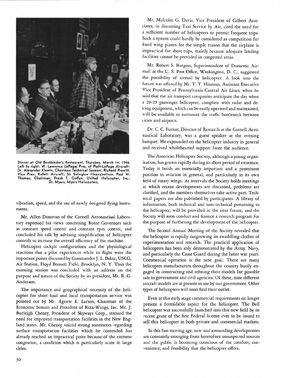
vibration, speed, and the use of newly designed flying instruments. Mr. Allen Donovan of the Cornell Aeronaurisal Laboratory expressed his views concerning Rotor Governors such as constant speed control and constant rpm control, and concluded his talk by advising simplification of helicopter controls to increase the overall efficiency of the machine. Helicopter cockpit configurations and - the physiological reactions that a pilot experiences while in flight were the important points discussed by Commander J. L. Baker, USCG, Air Station, Floyd Bennett Field, Brooklyn, N. Y. Thus the morning session was concluded with an address on the purpose and nature of the Society by its president, Mr. R. G. Anderson. The importance and geographical necessity of the helicopter for short haul and local transportation service was pointed out by Mr. Agnew E. Larsen, Chairman of the Economic Session and President of Rota-Wings, Inc. Mr. J. Burleigh Cheney, President of Skyways Corp., stressed the need for improved transportation facilities in the New England states. Mr. Cheney voiced strong statements regarding surface transportation facilities which he contended has already reached an impractical point because of the extreme congestion, a condition which is particularly acute in large cities. Mr. Malcolm G. Davis, Vice President of Gilbert Associates, in discussing Taxi Service by Air, cited the need for a sufficient number of helicopters to permit frequent trips. Such a system could hardly be considered as competition for fixed wing planes for the simple reason that the airplane is impractical for short trips, mainly because adequate landing facilities cannot be provided in congested areas. Mr. Robert S. Burgess, Superintendent of Domestic Airmail at the U. S. Post Office, Washington, D. C., suggested the possibility of airmail by helicopter. A look into the future was offered by Mr. T. T. Hinman, Assistant Executive Vice President of Pennsylvania Central Air Lines, when he said that the air transport companies anticipate the day when a 20-25 passenger helicopter, complete with radar and deicing equipment, which can be easily operated and maintained, will be available to surmount the traffic bottleneck between cities and airports. Dr. C C. Furnas, Director of Research at the Cornell Aeronautical Laboratory, was a guest speaker at the evening banquet. He expounded on the helicopter industry in general and received wholehearted support from the audience. The American Helicopter Society, although a young organization, has grown rapidly during its short period of existence. Today it holds an essentially important and a prominent position in aviation in general, and particularly in its own field of rotary wings. At intervals the Society holds meetings at which recent developments are discussed, problems are clarified, and the members themselves take active part. Technical papers are also published by participants. A library of information, both technical and non-technical pertaining to the helicopter, will be provided in the near future, and the Society will soon conduct and finance a research program for the purpose of furthering the development of the helicopter. The Second Annual Meeting of the Society revealed that the helicopter is rapidly outgrowing its swaddling clothes of experimentation and research. The practical application of helicopters has been ably demonstrated by the Army, Navy, and particularly the Coast Guard during the latter war years. Commercial operation is the next goal. There are many helicopter manufacturers throughout the country busily engaged in constructing and refining their models for possible sale to government and civil agencies. Of these, nine different aircraft models are at present in use by our government. Other types of-helicopters will soon find their outlet. Even at this early stage commercial requirements no longer present a formidable aspect for the helicopter. The Bell helicopter was successfully launched into this new field by its recent grant of the first Federal license ever to be issued to sell this helicopter in both private and commercial markets. In this fast-moving age, new and astounding developments are constantly emerging from heretofore unsuspected sources and the public is becoming conscious of the comfort, convenience, and feasibility that the helicopter offers. Dinner at Old Bookbinder's Restaurant, Thursday, March 14, 1946. Left to right: W. Lawrence LePage Pres. of Platt-LePage Aircraft; Dr. Alexander Klemin, Chairman Technical Session; Richard Prewitt, Vice Pres., Kellett Aircraft; Sir Swinglow Heavybottom, Paul W. Thomas, Chairman; Frank T. Coffyn, United Helicopter, Inc.; Dr. Myers, Myers Helicopters. |