May 1946 Pg26

|

|

|
Return to the 1946 thumbnail index

Home Page

© 1998-2017 www.americanhelicoptermag.com
|
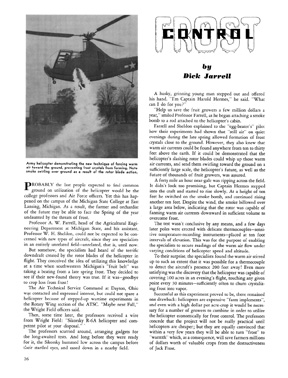
FROST CONTROL by Dick Jarrell Probably the last people expected to find common ground on utilization of the helicopter would be the college professors and Air Force officers. Yet this has happened on the campus of the Michigan State College at East Lansing, Michigan. As a result, the farmer and orchardist of the future may be able to face the Spring of the year undaunted by the threats of frost. Professor A. W. Farrell, head of the Agricultural Engineering Department at Michigan State, and his assistant, Professor W. H. Sheldon, could not be expected to be concerned with new types of aircraft, since they are specialists in an entirely unrelated field - unrelated, that is, until now. But somehow, the specialists had heard of the terrific downdraft created by the rotor blades of the helicopter in flight. They conceived the idea of utilizing this knowledge at a time when southwestern Michigan's "fruit belt" was taking a beating from a late spring frost. They decided to see if their new-found theory was true. If it was-goodbye to crop loss from frost! The Air Technical Service Command at Dayton, Ohio was contacted and expressed interest, but could not spare a helicopter because of stepped-up wartime experiments in the Rotary Wing section of the ATSC. "Maybe next Fall," the Wright Field officers said. Then, some time later, the professors received a wire from Wright Field: "Sikorsky R-6A helicopter and competent pilot at your disposal." The professors scurried around, arranging gadgets for the long-awaited tests. And long before they were ready for it, the Sikorsky hummed low across the campus before their startled eyes, and eased down in a nearby field. A husky, grinning young man stepped out and offered his hand. "I'm Captain Harold Hermes," he said. "What can I do for you?" "Help us save the fruit growers a few million dollars a year," smiled Professor Farrell, as he began attaching a smoke bomb to a rod attached to the helicopter's cabin. Farrell and Sheldon explained to the "egg-beater's" pilot how their experiments had shown that "still air" on quiet evenings during the late spring allowed formation of frost crystals close to the ground. However, they also knew that warm air currents could be found anywhere from ten to thirty feet above the earth. If it could be demonstrated that the helicopter's slashing rotor blades could whip up those warm air currents, and send them swirling toward the ground on a sufficiently large scale, the helicopter's future, as well as the future of thousands of fruit growers, was assured. A forty mile an hour near-gale was ripping across the field. It didn't look too promising, but Captain Hermes stepped into the craft and started to rise slowly. At a height of ten feet he switched on the smoke bomb, and continued rising another ten feet. Despite the wind, the smoke billowed over a large area below, indicating that the rotor was capable of fanning warm air currents downward in sufficient volume to overcome frost. The test wasn't conclusive by any means, and a few days later poles were erected with delicate thermocouples-sensitive temperature-recording instruments-placed at ten foot intervals of elevation. This was for the purpose of enabling the specialists to secure readings of the warm air flow under varying conditions of helicopter speed and altitude. To their surprise, the specialists found the warm air stirred up to such an extent that it was possible for a thermocouple to detect the aircraft's presence 200 feet away! Even more satisfying was the discovery that the helicopter was capable of covering 100 acres in an evening's flight, touching any given point every 30 minutes-sufficiently often to churn crystalizing frost into vapor. Successful as this experiment proved to be, there remained one drawback: helicopters are expensive "farm implements", and even with a high dollar per acre crop it would be necessary for a number of growers to combine in order to utilize the helicopter economically for frost control. The professors concede that the project will not be really practical until helicopters are cheaper; but they are equally convinced that within a very few years they will be able to turn "frost" to "warmth" which, as a consequence, will save farmers millions of dollars worth of valuable crops from the destructiveness of Jack Frost. Army helicopter demonstrating the new technique of forcing warm air toward the ground, preventing frost crystals from forming. Note smoke swirling over ground as a result of the rotor blade action. |