May 1946 Pg27

|

|

|
Return to the 1946 thumbnail index

Home Page

© 1998-2017 www.americanhelicoptermag.com
|
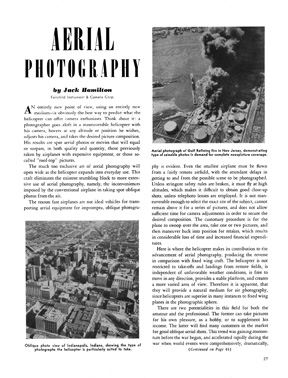
AERIAL PHOTOGRAPHY by Jack Hamilton Fairchild Instrument & Camera Corp. An entirely new point of view, using an entirely new medium - is obviously the best way to predict what the helicopter can offer camera enthusiasts. Think about it: a photographer goes aloft in a maneuverable helicopter with his camera, hovers at any altitude or position he wishes, adjusts his camera, and takes the desired picture composition. His results are spot aerial photos or movies that will equal or surpass, in both quality and quantity, those previously taken by airplanes with expensive equipment, or those so called "roof-top" pictures. The much too exclusive art of aerial photography will open wide as the helicopter expands into everyday use. This craft eliminates the existent stumbling block to more extensive use of aerial photography, namely, the inconveniences imposed by the conventional airplane in taking spot oblique photos from the air. The reason fast airplanes are not ideal vehicles for transporting aerial equipment for impromptu, oblique phorography is evident. Even the smallest airplane must be flown from a fairly remote airfield, with the attendant delays in getting to and from the possible scene to be photographed. Unless stringent safety rules are broken, it must fly at high altitudes, which makes it difficult to obtain good close-up shots, unless telephoto lenses are employed. It is not maneuverable enough to select the exact site of the subject, cannot remain above it for a series of pictures, and does not allow sufficient time for camera adjustments in order to secure the desired composition. The customary procedure is for the plane to swoop over the area, take one or two pictures, and then maneuver back into position for retakes, which results in considerable loss of time and increased financial expenditures. Here is where the helicopter makes its contribution to the advancement of aerial photography, producing the reverse in comparison with fixed wing craft. The helicopter is not restricted to take-offs and landings from remote fields, is independent of unfavorable weather conditions, is free to move in any direction, provides a stable platform, and creates a more varied area of view. Therefore it is apparent, that they will provide a natural medium for air photography, since helicopters are superior in many instances to fixed wing planes in the photographic sphere. There are two potentialities in this field for both the amateur and the professional. The former can take pictures for his own pleasure, as a hobby, or to supplement his income. The latter will find many customers in the market for good oblique aerial shots. This trend was gaining momentum before the war began, and accelerated rapidly during the war when world events were comprehensively, dramatically, (Continued on Page 43) Oblique photo view of Indianapolis, Indiana, showing the type of photographs the helicopter is particularly suited to take. Aerial photograph of Gulf Refining fire in New Jersey, demonstrating type of saleable photos in demand for complete newspicture coverage. |