May 1946 Pg25

|

|

|
Return to the 1946 thumbnail index

Home Page

© 1998-2017 www.americanhelicoptermag.com
|
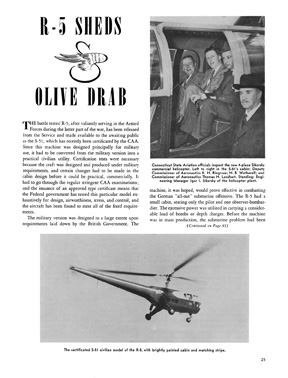
R-5 SHEDS OLIVE DRAB The battle tested R-5, after valiantly serving in the Armed Forces during the latter part of the war, has been released from the Service and made available to the awaiting public as the S- 51, which has recently been certificated by the CAA. Since this machine was designed principally for military use, it had to be converted from the military version into a practical civilian utility. Certification tests were necessary because the craft was designed and produced under military requirements, and certain changes had to be made in the cabin design before it could be practical, commercially. It had to go through the regular stringent CAA examinations; and the issuance of an approved type certificate means that the Federal government has tested this particular model exhaustively for design, airworthiness, stress, and control, and the aircraft has been found to meet all of the fixed requirements. The military version was designed to a large extent upon requirements laid down by the British Government. The machine, it was hoped, would prove effective in combatting the German "all-out" submarine offensive. The R-5 had a small cabin, seating only the pilot and one observer-bombardier. The excessive power was utilized in carrying a considerable load of bombs or depth charges. Before the machine was in mass production, the submarine problem had been (Continued on Page 43) Connecticut State Aviation officials inspect the new 4-place Sikorsky commercial helicopter. Left to right in the S-51 's cabin: Deputy Commissioner of Aeronautics K. H. Ringrose; H. B. Wetherell;. and Commissioner of Aeronautics Thomas H. Lockhart. Standing: Engineering Manager Igor I. Sikorsky of the helicopter plant. The certificated 5-51 civilian model of the R-5, with brightly painted cabin and matching stripe. |