May 1946 Pg12

|

|

|
Return to the 1946 thumbnail index

Home Page

© 1998-2017 www.americanhelicoptermag.com
|
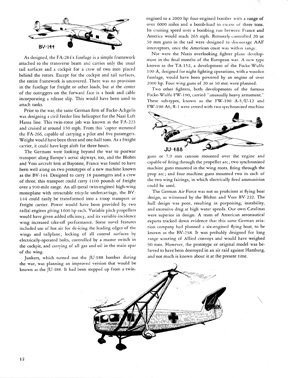
BV-144 As designed, the FA-284's fuselage is a simple framework attached to the transverse beam and carries only the usual tail surfaces and a cockpit for a crew of two men placed behind the rotors. Except for the cockpit and tail surfaces, the entire framework is uncovered. There was no provision in' the fuselage for freight or other loads, but at the center of the outriggers on the forward face is a hook and cable incorporating a release slip. This would have been used to attach tanks. Prior to the war, the same German firm of Focke-Achgelis was designing a civil feeder line helicopter for the Nazi Luft Hansa line. This twin-rotor job was known as the FA-223 and cruised at around 150 mph. From this 'copter stemmed the FA-266, capable of carrying a pilot and five passengers. Weight would have been three and one-half tons. As a freight carrier, it could have kept aloft for three hours. The Germans were looking beyond the war to postwar transport along Europe's aerial skyways, too, and the Blohm and Voss aircraft firm at Bayonne, France was found to have been well along on two prototypes of a new machine known as the BV-144. Designed to carry 18 passengers and a crew of three, this transport could carry 1100 pounds of freight over a 930-mile range. An all-metal twin-engined high-wing monoplane with retractable tricycle undercarriage, the BV- 144 could easily be transformed into a troop transport or freight carrier. Power would have been provided by two radial engines giving 1600 hp each. Variable pitch propellers would have given added efficiency, and its variable-incidence wing increased take-off performance. Some novel features included use of hot air for de-icing the leading edges of the wings and tail plane; locking of all control surfaces by electrically-operated bolts, controlled by a master switch in the cockpit, and carrying of all gas and oil in the main spar of the wing. Junkers, which turned out the JV-188 bomber during the war, was planning an improved version that would be known as the JV-488. It had been stepped up from a twin-engined to a 2000 hp four-engined bomber with a range of over 6000 miles and a bomb-load in excess of three tons .. Its cruising speed over a bombing run between France and America would reach 263 mph. Remotely-controlled 20 or 30 mm guns in the tail were designed to discourage AAF interceptors, once the American coast was within range. Nor were the Nazis overlooking fighter plane development in the final months of the European war. A new type known as the TA-152, a development of the Focke-Wulfe 109-A, designed for night fighting operations, with a wooden fuselage, would have been powered by an engine of over 2000 hp. Four wing guns of 20 or 30 mm were planned. Two other fighters, both developments of the famous Focke-Wulfe Fw-i90, carried "unusually heavy armament." These sub-types, known as the FW-190 A-5/U-12 and FW-190 A6/R-1 were armed with two synchronized machine guns or 7.9 mm cannon mounted over the engine and capable of firing through the propeller arc; two synchronized machine guns mounted in the wing roots, firing through the prop arc; and four machine guns mounted two in each of the two wing fairings, in which electrically fired ammunition could be used. The German Air Force was not so proficient at flying boat design, as witnessed by the Blohm and Voss BV-222. The hull design was poor, resulting in porpoising, instability, and excessive drag at high water speeds. Our own Catalinas were superior in design. A team of American aeronautical experts tracked down evidence that this same German aviation company had planned a six-engined flying boat, to be known as the BV-238. It was probably designed for long range scouting of Allied convoys and would have weighed 90 tons. However, the prototype or original model was believed to have been destroyed in an air raid against Hamburg, and not much is known about it at the present time. |