May 1946 Pg8-9

|

|

|
Return to the 1946 thumbnail index

Home Page

© 1998-2017 www.americanhelicoptermag.com
|
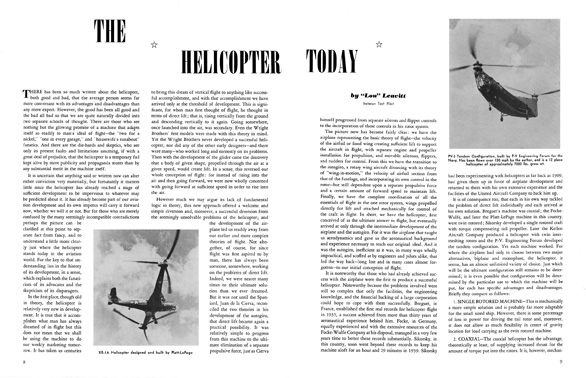
THE HELICOPTER TODAY by "Lou" Leavitt Veteran Test Pilot THERE has been so much written about the helicopter, both good and bad, that the average person seems far more conversant with its advantages and disadvantages than any mere expert. However, the good has been all good and the bad all bad so that we are quite naturally divided into two separate schools of thought. There are those who see nothing but the glowing promise of a machine that adapts itself so readily to man's ideal of flight-the "two for a nickel," "one in every garage," and "housewife's runabout" fanatics. And there are the die-hards and skeptics, who see only its present faults and limitations assuming, if with a great deal of prejudice, that the helicopter is a temporary fad kept alive by mere publicity and propaganda stunts than by any substantial merit in the machine itself. It is uncertain that anything said or written now can alter either conviction very materially, but fortunately it matters little since the helicopter has already reached a stage of sufficient development to be impervious to whatever may be predicted about it. It has already become part of our aviation development and its own impetus will carry it forward now, whether we will it or not. But for those who are merely confused by the many seemingly incompatible contradictions perhaps the picture can be clarified at this point to separate fact from fancy, and to understand a little more clearly just where the helicopter stands today in the aviation world. For the key to that understanding lies in the history of its development, in a sense, which explains both the fanaticism of its advocates and the skepticism of its disparagers. In the first place, though old in theory, the helicopter is relatively very new in development. It is true that it accomplishes what man has always dreamed of in flight but this does not mean that we shall be using the machine to do our weekly marketing tomorrow. It has taken us centuries to bring this dream of vertical flight to anything like successful accomplishment, and with that accomplishment we have arrived only at the threshold of development. This is significant, for when man first thought of flight, he thought in terms of direct lift; that is, rising vertically from the ground and descending vertically to it again. Going somewhere, once launched into the air, was secondary. Even the Wright Brothers' first models were made with this theory in mind. Yet the Wright Brothers never developed a successful helicopter, nor did any of the other early designers-and there were many-who worked long and earnestly on its problems. Then with the development of the glider came the discovery that a body of given shape, propelled through the air at a given speed; would create lift. In a sense, this reversed our whole conception of flight: for instead of rising into the air and then going forward, we were now wholly concerned with going forward at sufficient speed in order to rise into the air. However much we may argue its lack of fundamental logic in theory, this new approach offered a welcome and simple diversion and, moreover, a successful diversion from the seemingly unsolvable problems of the helicopter; and the development of the airplane led us readily away from our earlier and more complex theories of flight. Not altogether, of course, for since flight was first aspired to by man, there has always been someone, somewhere, working on the problems of direct lift. Indeed, we were nearer many times to their ultimate solution than we ever dreamed. But it was not until the Spaniard, Juan de la Cierva, reconciled the two theories in his development of the autogiro, that direct lift became again a practical possibility. It was relatively simple to progress from this machine to the ultimate elimination of a separate propulsive force, just as Cierva himself progressed from separate aileron and flipper controls to the incorporation of these controls in his rotor system. The picture now has become fairly clear: we have the airplane representing the basic theory of flight-the velocity of the airfoil or fixed wing creating sufficient lift to support the aircraft in flight, with separate engine and propeller installation for propulsion, and movable ailerons, flippers, and rudders for control. From this we have the transition to the autogiro, a rotary wing aircraft divorcing with its theory of "wing-in-motion," the velocity of airfoil section from that of the fuselage, and incorporating its own control in the rotor-but still dependent upon a separate propulsive force and a certain amount of forward speed to maintain lift. Finally, we have the complete coordination of all the essentials of flight in the one rotor system, wings propelled directly for lift and attached mechanically for control of the craft in flight. In short, we have the helicopter, first conceived of as the ultimate answer to flight, but eventually arrived at only through the intermediate development of the airplane and the autogiro. For it was the airplane that taught us aerodynamics and gave us the aeronautical background and experience necessary to reach our original ideal. And it was the autogiro, inefficient as it was, in many ways wholly impractical, and scoffed at by engineers and pilots alike, that led the way back-long lost and in many cases almost forgotten-to our initial conception of flight. It is noteworthy that those who had already achieved success with the airplane were the first to produce a successful helicopter. Noteworthy because the problems involved were still so complex that only the facilities, the engineering knowledge, and the financial backing of a large corporation could hope to cope with them successfully. Breguet, in France, established the first real records for helicopter flight in 1935, a success achieved from more than thirty years of aeronautical experience behind him. Focke, in Germany, equally experienced and with the extensive resources of the Focke-Wulfe Company at his disposal, managed in a very few years time to better these records substantially. Sikorsky, in this country, soon went beyond these records to keep his machine aloft for an hour and 29 minutes in 1939. Sikorsky had been experimenting with helicopters as far back as 1909, had given them up in favor of airplane development and returned to them with his own extensive experience and the facilities of the United Aircraft Company to back him up. It is of consequence too, that each in his own way tackled the problem of direct lift individually and each arrived at his own solution. Breguer's machine was coaxial; the FockeWuIfe, and later the PIatt-LePage machine in this countty, were twin rotored; Sikorsky developed a single rotored craft with torque compensating tail propeller. Later the Kellett Aircraft Company produced a helicopter with twin intermeshing rotors and the P-V. Engineering Forum developed the tandem configuration. Yet each machine worked. For where the airplane had only to choose between two major alternatives, biplane and monoplane, the helicopter, it seems, has an almost unlimited variety of choice. Just which will be the ultimate configuration still remains to be determined; it is even possible that configuration will be determined by the particular use to which the machine will be put, for each has specific advantages and disadvantages. Briefly they compare as follows: 1. SINGLE ROTORED MACHINE-This is mechanically a more simple solution and is probably far more adaptable for the small sized ship. However, there is some percentage of loss in power for driving the tail rotor and, moreover, it does not allow as much flexibility in center of gravity location for load carrying as the twin rotored machine. 2. COAXIAL-The coaxial helicopter has the advantage, theoretically at least, of supplying increased thrust for the amount of torque put into the rotors. It is, however, mechan- XR-1A Helicopter designed and built by Piatt-LePage PV-3 Tandem Configuration, built by P-V Engineering Forum for the Navy. Has been flown over 130 mph by the author, and is a 12 place helicopter of approximately 7000 Ibs. gross wt. |